The Importance of Tissue Analysis in Assessing Crop Nutrition and Nutrient Ratios

Joe Barfoot
Head of Horticulture, Nationwide
Effective crop nutrition isn’t just about what’s present in the soil, it’s about what the plant can efficiently take in and use. While soil analysis provides a foundation of what might be there, tissue analysis delivers a snapshot of a crop’s nutritional status from what it has been able to access previously, revealing how well nutrients are being absorbed and whether the plant is experiencing hidden or emerging imbalances.
Seeing Beyond Soil Supply
Soil tests measure nutrient availability, but uptake is influenced by countless dynamic factors, such as soil moisture, pH, microbial activity, root development, and environmental stress. Tissue analysis bridges this gap by showing the nutrients that have successfully entered the plant and moved into cells. This makes it an invaluable tool for verifying whether soil-applied fertilisers are performing as intended.
Detecting Deficiencies Before They’re Visible
By the time deficiency symptoms appear, yield potential is already compromised. Tissue analysis identifies subtle deviations in nutrient levels early, enabling timely corrective actions. This proactive approach is particularly important for mobile nutrients like nitrogen and magnesium, which can fluctuate rapidly during key growth stages. Sap analysis can also be used in conjunction to assess the immediate crop statis alongside tissue to get an even fuller picture.
Understanding Nutrient Ratios: The Key to Balanced Growth
Nutrient sufficiency isn’t only about absolute levels—ratios between nutrients are often just as critical. Imbalances such as high potassium suppressing magnesium uptake or excessive nitrogen diluting micronutrient concentrations can quietly hinder crop performance. Tissue analysis helps quantify these relationships, informing advisers to make more precise decisions on foliar feeds, top-dressing, and micronutrient inputs.
Driving Yield, Quality, and Efficiency
With clear insight into nutrient status, growers can target inputs more accurately, improving nutrient-use efficiency and reducing unnecessary applications. The result is healthier plants, stronger resilience, and more consistent yields, supported by data rather than assumptions.
Make Active Decisions, Without the Worry
Raw nutrient values alone don’t tell you if the plant is healthy.
When results are compared against established sufficiency ranges for that crop, you instantly see:
- Deficiencies
- Marginals
- Optimal values
- Excessive values
This gives agronomists, advisors and decision makers a framework for interpreting data rather than guessing, enabling key decisions to be made when looking at traditionally ‘balanced’ crops that indicate ‘in range’ but are low or excessive within said range.
Even if individual nutrients are ‘in range,’ imbalances between them can reduce efficiency.
Examples include:
- High K suppressing Mg uptake
- Excess N diluting micronutrient
- concentrations
- Fe antagonisms
Using nutrient ranges helps reveal these interactions early before they impact yield.
How can AIVA help?
Here at AIVA, we offer interpretations utilising our own analysis of the lab’s reports. Our tissue analysis reports draw from background data which considers optimal crop nutrition at key timings, especially where a nutrition strategy is already in place.
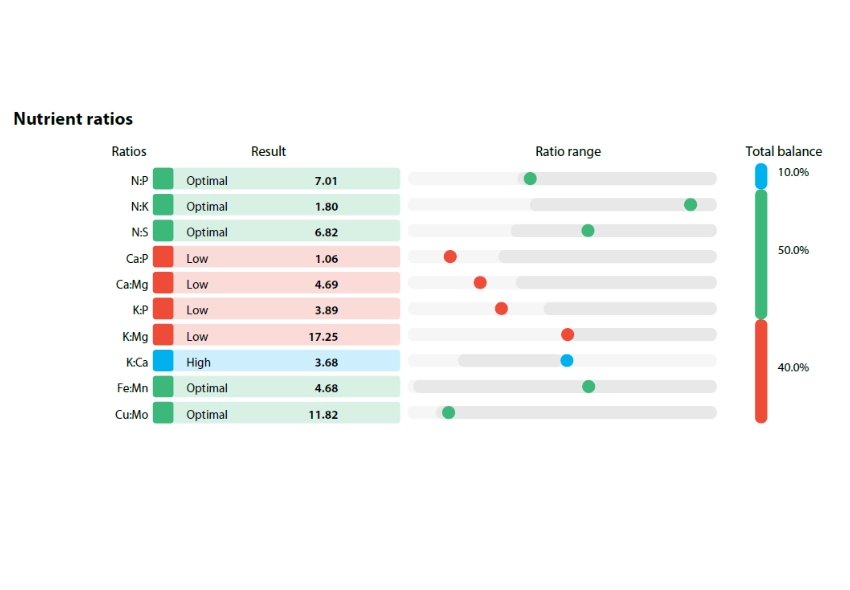
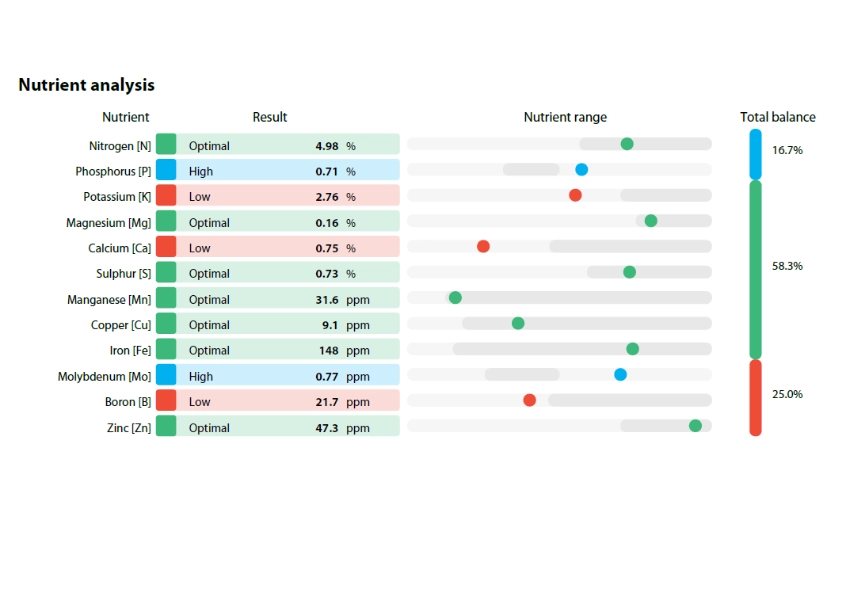
The reports run in three key indicator stages for both the nutrient analysis and the nutrient ratios:
- The result. Whether the nutrient is in range or not.
- The range. Where the nutrient is lies within the total nutrient range.
- The balance. How the balance of the analysis looks based on the nutrient result.
About the Author
Joe Barfoot
Head of Horticulture, Nationwide
Hello there! I’m Joe, Head of Horticulture at AIVA with a keen interest in nutrition within horticultural practices. I started my career developing arable systems with biological inputs, supporting the natural systems with nutrition and carbon. Creating balance, no matter the crop, is key to any system, biological or other.
Got a question? Contact Me.